Powering
Bold
Ideas
Ace Creatives
.svg)
©2024. All rights reserved.



Micro-Interactions
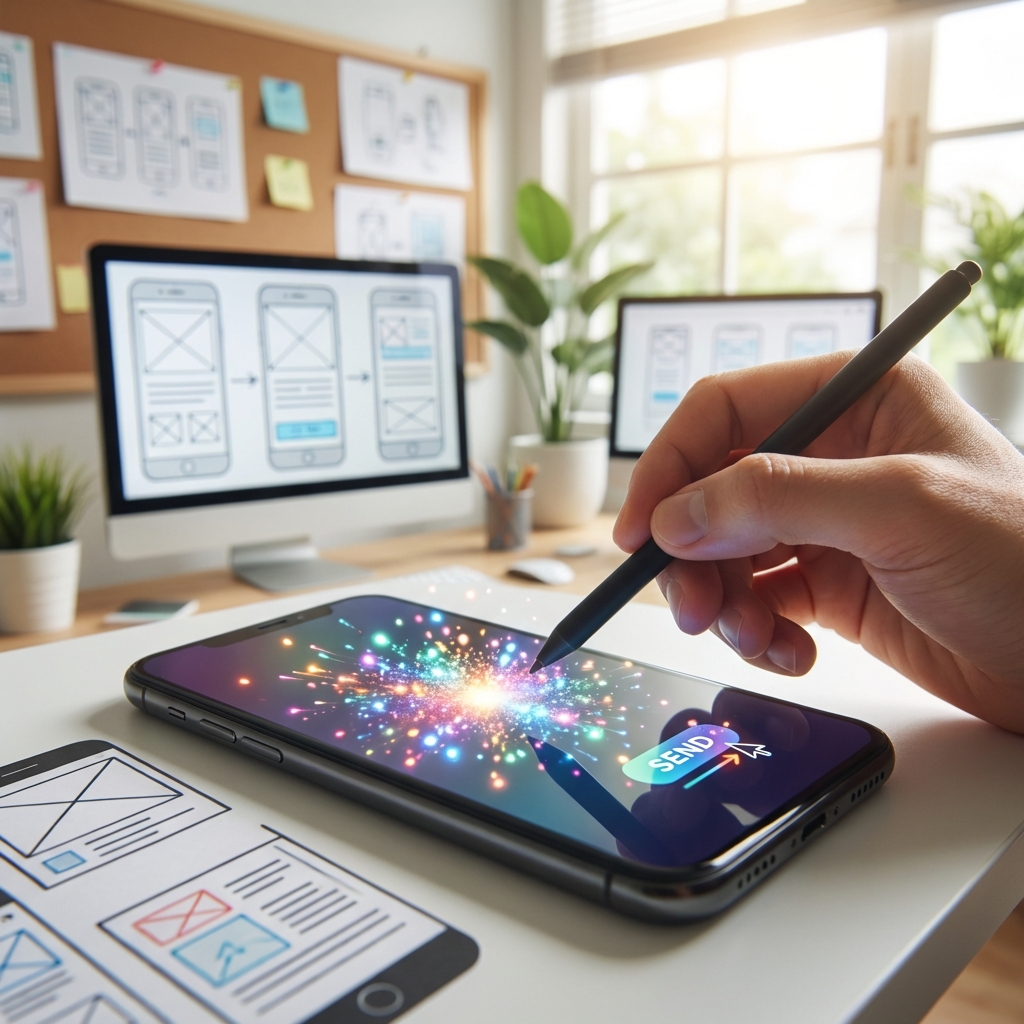
The Heartbeat of the Interface
In the war for attention, big features attract users, but small details keep them. Micro-interactions are the heartbeat of modern interface design—single-purpose events that trigger a feeling of satisfaction, guidance, and validation. They transform a static screen into a living, responsive environment. They are not merely "eye candy"; they are the very syntax of digital communication, providing the essential feedback loops that make a system feel responsive, intelligent, and human.
Think of the last time you used an app that felt "clunky." Chances are, it wasn't the core functionality that failed, but the lack of fluid response. It was the button that didn't depress when tapped, the list that didn't bounce back when scrolled to the end, or the form that waited until you hit "submit" to tell you your password was too short. These micro-failures accumulate, creating a subconscious friction that drives users away. Conversely, well-crafted micro-interactions grease the wheels of user experience, making complex tasks feel effortless and intuitive.

Functionality Meets Delight
A micro-interaction is a visual dialogue. It acknowledges a user's action. When you "pull to refresh" and hear that subtle pop, or when a "like" button bursts into confetti, the system is communicating: "I heard you, and I am working." Without these cues, digital experiences feel dead and unresponsive. This "system status visibility" is one of the ten heuristics of usability, but in 2026, we demand more than just visibility; we demand personality.
Consider the "typing awareness indicator"—those three dancing dots in a chat app. It conveys complex information: "The other person is present, they have read your message, and they are formulating a response." It builds anticipation and presence in a synchronous digital space. Without it, the silence would be deafening. These moments of "micro-delight" transform a utility into a companion.
At Ace Creatives, we engineer "Micro-Delight." We don't just use animations to look cool; we use them to reduce the perception of waiting times. A creative loader is less frustrating than a blank screen. A form field that validates visibly as you type prevents the frustration of submit-errors. These moments build a subconscious reservoir of goodwill towards the brand.
"The difference between a good product and a great product is rarely the features. It's the feeling. Micro-interactions cultivate that feeling."
The Psychology of Feedback Loops
Humans crave feedback. It gives us a sense of control. Micro-interactions tap into the same neurological loops as video games. They provide immediate rewards for interaction. A cohesive system of hovers, clicks, and transitions creates a tactile sensation, making the digital interface feel like a physical object. When you swipe a card away and it carries momentum, your brain registers the interface as having mass and physics, making it easier to predict and control.
This connection is primal. In the physical world, every action has an immediate reaction. If you push a door, it opens. If you drop a glass, it shatters. Digital interfaces that lack this immediate feedback disconnect us from the experience. By reintroducing physics—inertia, spring, gravity—into our UI, we bridge the gap between the screen and the user's mind. We make the pixelated world feel tangible.
Guidance and Education
Micro-interactions also serve as teachers. A subtle bounce can draw attention to a notification. A swipe hint can teach a new gesture without a tutorial. By using motion to lead the eye, we reduce the learning curve of complex applications, making power-user features accessible to everyone. Instead of reading a manual, the user learns by doing, guided by the organic responses of the interface itself.
For example, when a user enters invalid data, a rough "shake" animation communicates "no" universally, transcending language barriers. When a file is dragged over a drop zone, the zone expands and pulsates, inviting the drop. These are not decorative choices; they are functional instructions encoded in motion.
Don't ignore the small stuff. In a crowded digital marketplace, polished micro-interactions are the signifier of a premium product. They are the difference between a tool you tolerate and a tool you love.